
Train rides really help advancing in your reading list. This time I was accompanied by Steven D. Levitt and Stephen J. Dubner’s follow-up to their bestseller Freakonomics

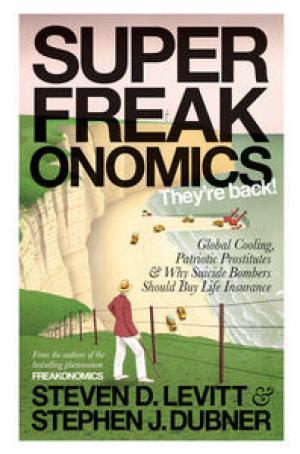
The book contains a couple of gems of information that will always come handy at parties, like the fact that after sex changes men (who originally used to be women) will earn more than before, while their newly female counterparts will see their salaries drop.
The main theme of Superfreakonomics is the power and importance of incentives. The question why people do things or how they could be motivated to do things is the red thread along which Levitt and Dubner shed light at subjects like prostitution, altruism, global warming, terrorism and simple solutions. For instance, the best motivation for hospital staff and doctors to wash their hands is to have them culture their hands‘ surfaces in petri dishes and display the colorful results on all screen savers in the clinic. In that aspect Superfreakonomics is stuffed full with the interesting.
When Dubner (I believe that’s his shtick) drifts off to see whether the infamous Kitty Genovese incident might have been inaccurately reported or covers many different viewpoints and ideas on global warming, plus some science fiction sounding solutions, I was not too excited.
The freakonomicists are most interesting when they let data and science reveal the unexpected: how for instance TV did more to empower women in India than all prior government interventions. The short last chapter is a highlight: it describes Keith Chen’s experiment in which capuchin monkeys were taught the concept of money (exchanging coins for food). It resulted in the monkeys behaving like stock-market investors at the prospect of loss, but also in theft, greed and …wait for it… prostitution. The experiment was halted because it was feared that it would damage the monkey’s social structure.
In summary, Superfreakonomics
 . Zimbardo is best known for conducting the 1971 Stanford Prison Experiment and he revisited his notorious experiment while working as an advisor for the defense in the Abu Ghraib trials. His report of the experiment, but also of other crimes and the Abu Ghraib abuses is chilling, but it is worth reading because he filters his findings into 7 factors that take good people down the road to evil. Very simple truths that can be observed wherever we hurt each other.