Breakfast is for lovers…

The Lurpak campaign by Wieden+Kennedy, London is one of my favourite recent advertising campaigns. I like the insight and strategy behind it and how they were translated into marvellous ads (with long copy). The rhythm, images and focus on what good you can make with Lurpak (instead of promising some super-healthy proposition) are a pleasing contrast to the usual screaming of advertising.

Yesterday evening a new series of print and television ads went on air:  ”Saturday is Breakfast Day” (via the W+K London blog). 

Inspire people to make Saturday a breakfast day. The brilliant copy and images are mouthwatering and inspiring. Again, the focus is on something you can make WITH Lurpak instead of some obscure promise what Lurpak does for you. Improve your Saturday, enjoy a wonderful breakfast, add Lurpak. Brilliant.

 I believe this resonates with many people in general (breakfast people like my wife or non-breakfast people like me) and Britain’s situation in particular.

It is hardly a coincidence that this piece appeared in today’s Times. Camilla Cavendish makes observations about the British and food that could very well be in the brief for the Lurpak campaign:

Most of us are confused. [...] We balk at paying for raw ingredients, but readily cough up for extortionate ready meals. We spend hours watching TV chefs but apparently only 13 minutes on average making a meal – down from one hour in 1980.

and the last paragraph, where she recalls Carlo Petrini, founder of Slow Food, drawing the contrast

between Britain’s “pornographic” onslaught of recipes and TV chefs, and the “act of true love” that he believes is making food from traditional, local ingredients. 

Imagine that commercial.

Let’s be clear what we are talking about…

Last week this commercial for the Austrian Lotteries went on air. I actually like it. It has a good idea, the main protagonist is perfectly cast and it is amazingly subtle and still funny – for Austrian standards.

Last year’s “Dog” was also a good idea in my eyes. Got Lowe GGK showered in awards, but internationally only shortlisted (i.e. Cannes). 

Yet, despite being brilliant ideas and quite successful, I believe these ads could look a lot better if the agency would be clearer about what they are talking about.

These commercial have a looong history: Along with the tagline “Alles ist möglich” / “Everything is possible” they have been showing the depressing status quo of a person contrasted with the glorious golden future of that person being a lottery winner.

These two commercials have completely left that look-at-that-terrible-job-you-are-in-now-and-the-lottery-will-get-you-out-of-there strategy and tell a much clearer message:

Play the lottery because it will you make so filthy rich that [insert commercial idea here]

I have my doubts that there has been a true strategical decision towards this message. Rather good ideas that were pressed into the old corset. The execution is still stuck in that old tradition of how these spots must be made.

So in “Opera” they spend 15 seconds telling nothing of relevance, because that was the way we have always done it. It makes no sense, does neither help story nor punchline, and it costs extra money each time the ad is aired. And it will go no further than the Cannes shortlist.

Just my two cents.

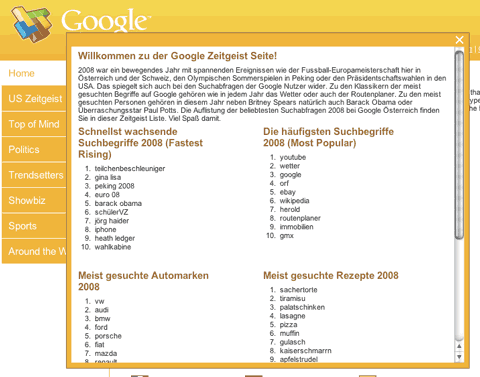
Google Zeitgeist 2008

Google has published Google Zeitgeist 2008 this week. This yearly summary of the year’s most popular searches at Google. So what is interesting here? 

Google Zeitgeist 2008

The results for the most popular searches in Austria are odd: youtube, orf, ebay, hotmail, wikipedia, herold… Not just Austria, all over the world people seem to mix up address bar and the search field.

This implies a few things: first, this seems to be a basic design flaw in internet browsers. Of course, the address bar is commonly placed on top, but for most people attention is drawn to the all important input field in the center of the start page. (Or, if I recall correctly, in Internet Explorer people’s inputs in the address bar are redirected to a search engine when no website is found)

Whatever the cause one can’t help but notice, secondly, people (the significant majority) are nowhere near internet-savvy. In some countries more, in some countries less. Really successful in the web business are the people who really acknowledge and exploit this fact: hackers, phishers and spammers. On the legal end of the spectrum, most internet advertising and market seems to just talk and connect to the experienced internet user segment.

Thirdly: Why bother printing your web-address on ads? Or, if you are internet service like check24.de or monster.at: Why bother confusing your clients with adresses? What has to stick is the brand name, and then you have to make sure you own the search results when it is entered.

And lastly, it probably pays to buy yourself into the searches for names of your competitors. Say someone wants to get to eBay, googles eBay and as first result gets the paid ad for Ricardo.at, an Austrian auctioning site. Admittedly, eBay know their stuff too well, but for most other brands you can position yourself right in front of your competition’s gates.

New Amnesty International commercial: “You Are Powerful”

Usually, I am not a big fan of the commercials made for AI or other human rights groups. Most of them feel like lion bait with lots of emotion, shock etc. instead of seriously trying to win people for the cause.

But I do like this new commercial for Amnesty International. I like that it dramatically visualizes what I believe Amnesty is about (and why I am a member): normal people stepping in when human rights are violated. You might discuss the effect that effort has in reality, as in the YouTube comments. But without Amnesty and all the people engaging, the world would be a much worser place.

Edit: Agency is Mother, London. http://www.motherlondon.com/

This is so sad.

Sometimes you get a feeling that advertising hates little kids. Why else would anyone do this?


via Consumerist

Stay true.

honest ed's
via Flickr by Greencolander

I ran into this the other day: Kevin Proudfoot talks Intimacy It is just a short list/summary which I found to be a pretty a good reminder of the golden rules of establishing meaningful communication with consumers. I believe there is no way around them:

  • Let the person know you’re thinking about them. Consider the user.
  • Talk directly to them. Eye level.
  • Enable and encourage them to be themselves. Let people reflect themselves.( (i.e. customized Nikes)
  • Avoid schizophrenia. Find one voice.

And then this washed up here and reminded me of the one rule to rule them all:

  • DO. NOT. LIE. Reminder: It’s the age of the internet, if you are not honest, it will resurface as certain as a celebrity sex tape.

What will be the implications for the Dove campaign should it really be the case that their images were heavily retouched? Other than disastrous? I mean, doing EXACTLY the opposite of what you claim to do. What were they thinking?

This does not mean I am fully convinced by the story, but the damage is already done because the Ogilvy PR person was not quick enough to say “WTF?! Who is this guy?”. “We have to check..” sounds more like ” I am not sure what to answer. Please stand by till I have made up the proper lie.” This is a symptom of an inconsistent story and in an interrogation room Dove would now be screwed.

I remember this story of an retiring politician (as incredible as it sounds, I think that was the case): he was praised by colleagues and the press that he never forgot a name, a commitment, a discussion or a face. When asked how he archieved that, he answered: “Oh. That was easy. I never told a lie.”

It is true. If you find an honest tone and message, communication will be easy. You will know what to do, what to say and you (or your press spokesperson) won’t have to remember all the lies you told.


Ford feeds monsters

Claim says: “Now with more space for humans”. Well, let’s just say that this is one way to illustrate that the Ford Ka has lots of space inside. I like it.

Via Nerdcore